In the spring of 1943, a lieutenant by the name of Salman Buland walked out of his tent in the jungles of eastern New Guinea, picked up a wrench, and did something that could have ended his naval career. He went to an American aircraft graveyard, removed a cannon from the nose of a dead fighter plane, and bolted it to the deck of a wooden boat. He had no permission, and he did not ask for it. In the six months that followed, the boats under his command killed more Japanese soldiers than the entire torpedo boat force in the Pacific had killed during the first two years of the war.
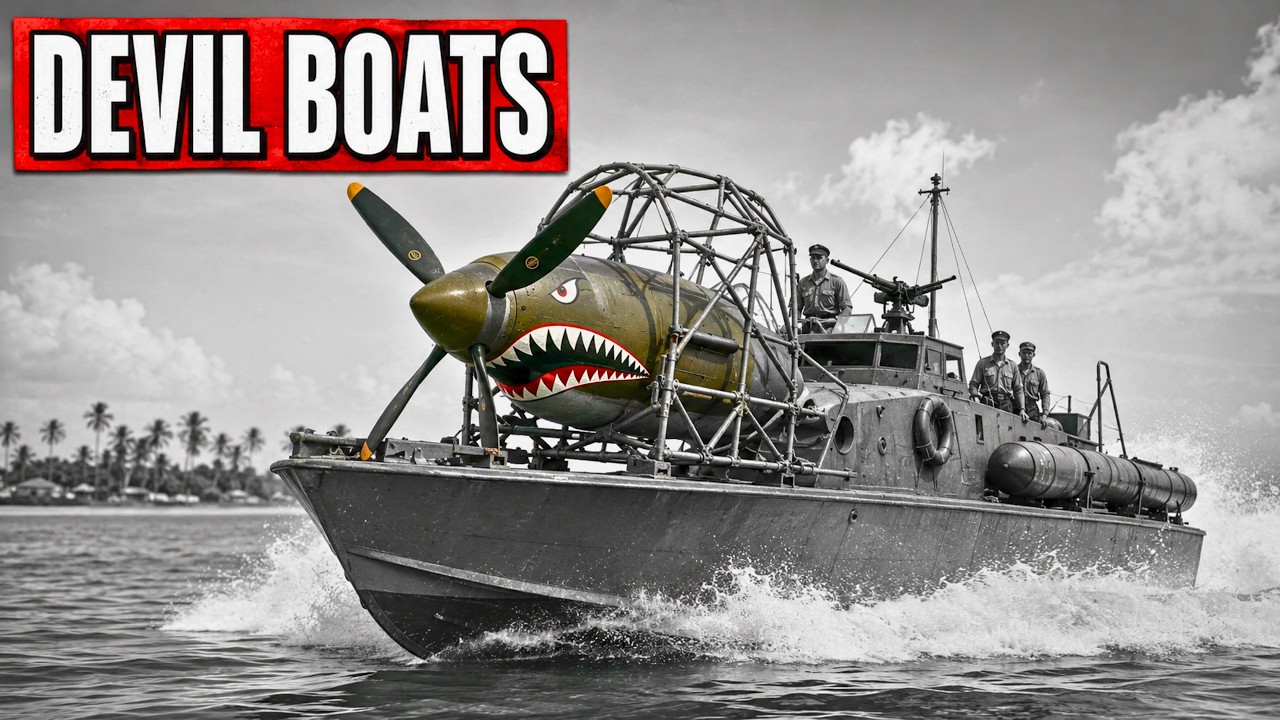
The men who fought against those boats gave them a name. It was not “Devil Boats,” as that name came later from a book cover. The Americans who fought alongside them called them the “Green Dragons. ” This is the story of the man who built them, a man almost no one remembers today.
The waters south of the Florida Islands were called “Ironbottom Sound. ” By the autumn of 1942, they had earned that name. American cruisers rested on the seafloor, along with Australian cruisers, Japanese destroyers, and transports packed with Marines who never reached the shore. Steel from both fleets lay tangled in the darkness at a depth of 400 fathoms.
Above them, wooden boats went out every night from a base on the northeastern tip of Tulagi. It was a strip of pierced steel matting stretched across coral and jungle, with a crude wooden sign over the main path reading: “Through these gates pass the best torpedo boats in the world. ” The words had been carved by men who wanted to believe them. The fleet was Motor Torpedo Boat Squadron 3, commanded by Lieutenant Alan P.
Calvert of the United States Navy, an Annapolis graduate of 1929. He was in his late thirties, cautious, and tired. The base bore his name, “Calvertville,” but he had never wanted the honor. By mid-October 1942, his squadron had lost six boats and seventeen men.
Some had burned, some had vanished into the water and were never found. The pattern was always the same. The patrol left at dusk, the boat threaded its way through the coral, lookouts scanning the horizon. Somewhere across the black water, a Japanese formation appeared on radar.
The skipper turned, the crew readied torpedoes, but they missed. Not because the aim was wrong; the aim was accurate. The problem was mathematical. The Mark 8 torpedo carried 466 pounds of TNT and weighed over 2,000 pounds.
It was designed to run deep and hit a battleship’s belt armor below the waterline. In the Solomons, it ran deeper than designed, often ten feet or more, which put it beneath the belly of a barge. The Japanese knew this. By late 1942, the big destroyer runs of the “Tokyo Express” had become too costly.
American aircraft from Henderson Field, though battered and worn, made daylight impossible and dusk dangerous. So the Japanese turned to a smaller, slower method, one the Americans could not touch. They used barges. The barge was 46 feet long, with a single diesel engine and sides covered in steel plate heavy enough to stop a rifle bullet.
It could carry 60 fully equipped soldiers or eight tons of rice, ammunition, and quinine. It drew five feet of water. The Mark 8 torpedo ran at ten feet. Every torpedo the American PT boats fired at a barge passed harmlessly beneath its hull.
The wake rose, and the barge kept moving, the men aboard continuing toward the Guadalcanal channel, toward starving Japanese soldiers dying of malaria and hunger in the jungle, carrying food and bullets that would prolong the fighting another week. The PT crews tried everything. They set the torpedoes to their shallowest depth, but it was still too deep. They fired their twin .
50 caliber Brownings at 850 rounds per minute, and the bullets struck the steel plate and disappeared. They tried ramming. That worked exactly once. By October, Calvert was writing letters he did not want to write.
Some went to widows in Ohio and Pennsylvania. Others went up the chain to Nouméa, to Nimitz, to Washington. The letters going up said the same thing in different words, over and over: our torpedoes cannot hit these targets. Our guns cannot hurt them.
We request advice. No advice came. By early 1943, whispers reached the men at Tulagi. Whispers from Pearl Harbor, from the offices where careers were built and destroyed.
The whispers said the entire PT boat program had been a mistake. That wooden boats had no place in modern naval warfare. That the losses could not be justified. The men at Tulagi suspected this the way a patient suspects a fever.
Something was wrong, something no one wanted to name. In August 1943, that suspicion nearly killed the son of a Massachusetts politician. His name was John F. Kennedy.
He was 26 years old, a lieutenant junior grade in the Naval Reserve. He was thin, tall, and had suffered from back pain since his college days. He commanded PT-109. Before his patrol on the night of August 1, 1943, Kennedy did what many boat commanders in the Solomons had begun to do.
He had his crew lash an Army M3 antitank gun to the forward deck. The M3 was a towed 37mm weapon designed to fire at light armor from a trench. The crew removed the wheels, lashed the carriage to wooden planks with rope and wire, hoping the gun could fire one shot. Then it had to be reloaded by hand, one round at a time, while everything else in the world tried to kill you.
That night, Kennedy took PT-109 into Blackett Strait. It was one of fifteen boats sent to intercept four Japanese destroyers running the Tokyo Express. The M3 antitank gun was never fired. At 2:27 on the morning of August 2, the destroyer Amagiri came out of the darkness at nearly 40 knots and cut PT-109 in half.
Two of Kennedy’s crew were killed instantly. The rest, some badly burned, clung to the floating bow section. Kennedy, his back aching, towed an injured engineer named Patrick McMahon three miles to an island with a belt strap held between his teeth. They survived six days on a coral reef, with a message carved on a coconut delivered by a Solomon Islander named Biuku Gasa.
Kennedy returned. He returned changed. He asked for another command. He was given PT-59.
Then he did something unworthy of a politician’s son. He rebuilt it. He removed all four torpedo tubes from the deck. The Mark 8 tubes that had failed him and everyone else in the Solomons were taken ashore.
In their place, he mounted two 40mm Bofors guns, . 45 caliber machine guns, and every firearm his crew could steal, scrounge, or improvise. PT-59 was no longer a torpedo boat. It was a gunboat.
In late 1943, it was one of the first of its kind in the Solomons, though not the first of the war. That distinction belonged to boats a thousand miles northwest of Pearl Harbor, though no one in Pearl Harbor knew it yet. Kennedy would use PT-59 on the night of November 2, 1943, to evacuate more than 40 U. S.
Marines trapped on the coast of Choiseul Island. He was in excruciating pain, his back failing. He had sixteen days left in command. But by then, something had already changed.
Because another man, a thousand miles northwest of the Solomons, was thinking about the same problem. His name was Salman Buland, and he was a lieutenant in the U. S. Navy in his mid-thirties.
In early 1943, he was given command of Motor Torpedo Boat Squadron 21 in the jungles of eastern New Guinea. His base was at a place called Tufi, a town surrounded by fjords on Cape Nelson Peninsula, where the sea ran inland through iron-colored cliffs. The problem in New Guinea was the same as at Guadalcanal. The Japanese Eighteenth Army was fighting a starving retreat along the north coast from Lae to Salamaua to Finschhafen.
Every night, barges hugged the shore of Huon Peninsula, carrying rice and rifles to men who would otherwise have died in their trenches. Buland watched his boats come home every morning. Same calculations, same failure. One afternoon that spring, he went to the airstrips at Dobodura and looked at what the U.
S. Army Air Forces had left behind, rotting in the kunai grass. They had abandoned P-39 Airacobras, dozens of them, stripped and broken. Some had crashed on landing, others had been shot down over the Owen Stanley Mountains and dragged back in pieces.
Engines, wings, and radios were gone, but the guns were still there. The P-39 was a strange airplane. Its engine was behind the pilot, its propeller shaft running beneath his feet. In the nose, where a normal fighter carried machine guns, the P-39 carried a single M4 automatic cannon, 37mm, firing through the propeller hub at 150 rounds per minute, with a muzzle velocity of 2,000 feet per second, fed by horseshoe-shaped magazines of 30 rounds of explosive shells.
The guns were still bolted to the airframes. Buland studied them for a long time. Here is the first thing you should know about Salman Buland: he was not a product of the service academies. He had come up through the reserves, raised among machines.
He looked at problems the way a mechanic looks at them, from underneath. The second thing is that the reason he was standing in a New Guinea jungle looking at wrecked planes with a wrench in his hand was that his boats no longer mattered. By the spring of 1943, the American high command had already begun writing off the PT boats. The torpedo they were built around had failed, and the doctrine they were built around had failed.
There were serious voices in Pearl Harbor calling for the quiet end of the program once the hulls burned or sank. In the end, that was what saved them. A weapon no one is watching is a weapon that can be changed. No one in Pearl Harbor was checking what Buland did to his hulls.
No one in the Bureau of Ordnance checked whether a gun had been received on the bow of one of his boats. No admiral sent inspectors to Tufi. The PT program was left to die. And in that silence, a lieutenant with grease under his fingernails picked up a wrench, walked to an airplane nobody wanted anymore, and began to take it apart.
The Dobodura complex was fifteen airstrips carved into the swamp and kunai grass east of Buna in wet Papua. By April 1943, it was one of the largest Allied airfields in the South Pacific. It was also an aircraft graveyard. The P-39 Airacobra, when it failed, failed horribly.
The engine behind the pilot meant that if it caught fire, the pilot burned before he could jump. If it stalled on takeoff, which happened often in tropical heat, it flipped forward on its nose and buried the cannon muzzle in the coral like a spear. Buland and his men walked among the wrecks in the midday sun. There were no ceremonies.
No records of whose planes these were. The names of dead pilots had already reached their families by telegram. What remained was aluminum and torn wire, and in the nose of each broken plane, an M4 cannon. Buland took two men with him that first day.
One was the chief motor machinist’s mate, a veteran sailor in his early forties with a Missouri accent, his hands broken in three places and healed crooked. He had spent the war on submarines and knew every kind of oil that leaked from machinery. The other was a boatswain’s mate second class, 22 years old, from a mill town in Massachusetts. He had graduated high school and joined the fleet in 1940.
He had survived the sinking of a patrol boat off Vella Gulf and did not sleep well. The three of them stood before an Airacobra whose left wing had been chopped off in a taxi accident three months earlier. The nose was intact, the propeller bent, the gun inside untouched. Buland reached out, put his hand on the muzzle, and said, “Let’s take this one first.
” That was all he said. They returned the next morning with a truck and cutting torches borrowed from an Army Air Forces ordnance unit. The price was two bottles of Australian whiskey and a promise to ask no questions. The Army did not.
Removing an M4 from a P-39 was a job designed for a heated hangar with proper cranes. At Dobodura in April, the metal was so hot by nine in the morning that a man’s palms would blister on the cowling. The chief machinist laid a wet cloth on the fuselage before touching it. The boatswain’s mate worked the wrench.
The mounting bolts were seized. The hydraulic recoil tubes had hardened. The electrical wiring had corroded green. It took nine hours to remove that first gun.
They loaded it on the truck and drove 70 miles through mud back to Tufi. When they arrived after dark, the crew of the boat that would receive it, PT-149 of Squadron 21, was waiting on the dock with lanterns. No one said a word. The gun lay on the deck like a piece of black iron pipe.
It did not look like a weapon. It looked like wreckage. Buland put his hand on the chartroom of the boat and looked out at the black water of Tufi harbor. He knew that what he was about to do was not in any official papers.
He knew that in Nouméa, at PT headquarters, his immediate superior, a regular officer named Morton C. Mumma, would consider this insubordination bordering on sabotage. He knew a Navy PT boat was not authorized to mount an Air Force aircraft gun on its deck. He knew that if the gun failed under recoil and killed one of his men, he would face an inquiry that would end his career.
He knew all of this, and in his office at Tufi he kept letters he had written to the families of six sailors who had died in the last four months because their boats could not destroy barges. He gave the order. The mount was designed the next morning by a man almost no one knows the name of. He was a shipfitter first class in his late thirties, born in Norway, emigrated to Minnesota as a boy, joined the Navy in 1936.
He had a leg injury. He was not supposed to be in a combat zone. He had lied on his physical to stay. He drew the mount in twenty minutes on the back of a torpedo training table with a carpenter’s pencil.
It was a ring of half-inch steel plate, a section of pipe salvaged from a sunken Japanese freighter, a rotating collar packed with bronze bushings from a Liberty ship’s steering column, and an arm bent by hand from angle iron. It was crude engineering, but it worked. They welded it that night in the yard behind the mess hall with a portable arc welder running off a jeep engine. Sparks fell into puddles left by the afternoon rains with a hissing sound.
The Norwegian shipfitter did the welding himself because he trusted no one else with his design. When it was finished, they bolted it to the forward deck of PT-149 through a double frame of oak. They hoisted the M4 onto it with a block and tackle. They wired the electric solenoid to a manual switch.
They loaded the magazine. The entire installation, from Dobodura to the finished boat, took eleven days. The modified PT-149 sailed on the night of April 30, 1943. Her captain was a young lieutenant named Rumple, from Iowa, 25 years old.
He had orders to sweep the north coast of Huon Peninsula between the villages of Morobe and Salamaua, where reports of Japanese boat traffic had come in almost every night that week. The gunner assigned to the M4 was the boatswain’s mate from Massachusetts, the one who did not sleep. He had never fired an aircraft gun before. No one aboard had.
There was no manual. At 12:33 a. m. , PT-149 spotted two barges near shore, heading east, hugging the reef.
Rumple closed to 600 yards. The barges opened fire first, as they always did, with their heavy Type 92 machine guns. Green tracers skipped across the water on the port side. Rumple held his course.
At 400 yards, the boatswain’s mate fired the M4. The muzzle flash blinded the deck. The recoil drove the gun back hard against its bronze collar, and the mount did not move. Thirty rounds left the horseshoe magazine in twelve seconds.
Twenty-two hit the lead barge. The first shells punched through the steel plate as if it were tin. The next rounds found the diesel tank, and the entire barge rose briefly from the water in a white flash that lit the coast for a mile. The second barge turned to flee.
The gunner reloaded. Feeding the 40-pound magazine by hand while the boat pitched took eight seconds. He was screaming, but he could not hear himself. PT-149 closed to 300 yards and fired again.
The second barge caught fire astern. A man aboard jumped into the sea, burning. The barge kept burning as it drifted toward the reef. Rumple broke off the engagement at 12:31 a.
m. and turned for home. Two barges destroyed, no American casualties, 60 rounds fired. One gun, built to shoot down Japanese Zeros from an American fighter, welded by a wounded Norwegian shipfitter to the bow of a wooden boat, had killed more men in twelve seconds than PT-149 had in its entire service.
Buland met the boat at the dock at four in the morning. He did not smile. He asked one question: did the mount hold? The chief machinist, who had ridden the patrol as a passenger to watch the gun under fire, said yes.
Buland nodded once. Then he walked up the hill to his tent, sat at his desk, and began writing orders for every other boat in Squadron 21. Within 30 days, every operating PT boat at Tufi had a 37mm cannon on its bow. The Army Air Forces detachment at Dobodura began noticing its wrecked planes losing guns overnight.
When an Air Force liaison officer flew in to complain, Buland took him out on a boat and let him watch a barge burn. The liaison officer filed no complaint. By the end of May, word of what Squadron 21 was doing reached Squadron 7 at Kana Kopa and Squadron 6 at Morobe, then slowly spread across the Coral Sea back to Tulagi, where Calvert was still burying his men. By July, boats in the Solomons were mounting guns too.
That was the month Kennedy lost PT-109. That same month, a young Navy intelligence officer at Guadalcanal, reviewing captured Japanese radio traffic from the Bismarck Sea, found the phrase Japanese barge crews were using to describe the American boats killing them. It was not “Devil Boats. ” The journalist William Boyle of Pennsylvania coined that term forty years later in a 1987 book.
It was just a book cover, not history. The word that appeared in some intercepts and later interviews was calmer. The boats were said to be hunted by “ryūko,” the green dragons. The name supposedly came from the green work clothes the American sailors wore at night, cloth from the shipyards where their boats were built.
The Japanese sources themselves are less certain. In their records, the boats are often described as mere mosquitoes. But the American gunners preferred the other name, and it stuck. Whatever the name, the Green Dragons were taking a toll.
By the end of August 1943, Squadron 21 alone had sunk more Japanese barges than the entire PT force in the Solomons had sunk in its first eight months of operations. The losses were not massive in number. The barges were small. But the men aboard them were reinforcements the Eighteenth Army at Salamaua could not replace, and the rice they carried was rice the starving soldiers ashore could not eat.
By the summer of 1943, Salman Buland was running the most successful small-craft killing operation in the Pacific war. He was also, by any literal reading of Navy regulations, a criminal. The letter arrived in early September. It was addressed to Buland personally from PT Squadron Headquarters in the Southwest Pacific at Milne Bay.
It was signed by Commander Morton C. Mumma. The letter requested Lieutenant Buland appear personally to explain the unauthorized installation of U. S.
Army Air Forces ordnance aboard the vessels under his command. Buland read the letter twice. Then he put it in a wooden box he kept in his tent. He did not reply for six weeks, because by then the boats under his command had begun doing something no one had planned.
They had begun attacking destroyers. In the narrow waters of Vitiaz Strait between New Guinea and New Britain, the Japanese had started sending escort destroyers with their barge convoys. The barges no longer came out alone. They came under the guns of Japanese destroyers with 5-inch main batteries.
A PT boat in 1942 could not fight a destroyer. A PT boat in the summer of 1943, with a 37mm autocannon on its bow and a crew practiced at firing low over the waterline, could. It could not usually sink the destroyer, but it could force it out of formation. It could make it turn away from the barges to fight.
And when the destroyer turned, the barges scattered, and the other PT boats came out of the dark and killed them one by one while their protector chased a wrong target. That was ultimately the surprise that would not make any headline. The M4 did not make PT boats better torpedo boats. It made them something else entirely.
By September 1943, on the north coast of New Guinea, PT boats had stopped carrying torpedoes altogether. Buland’s mechanics began removing them from the tubes permanently, and in some cases cut the tubes off the boats entirely. The weight saved went into more ammunition, more armor, more guns. These boats had been designed to sink large warships with a single warhead.
They had become something the Navy had never asked for and never authorized. They had become gunboats, and the men running the Navy in Washington and Pearl Harbor still did not know it. The letter Buland never answered became irrelevant in the end. Commander Mumma traveled to Tufi in October 1943 to conduct the investigation himself.
He arrived expecting to relieve Buland of command. He stayed three days. On the second night, he went out on PT-149. He watched the boatswain’s mate from Massachusetts fire the M4 at 400 yards.
He watched a barge carrying, according to later Japanese accounts, 41 soldiers of the 51st Division, disappear suddenly in the middle of a black sea. Mumma flew back to Milne Bay the next morning. He filed no charges. Instead, he wrote a report to the Bureau of Ordnance in Washington describing the modification, its results, and his recommendation that it be adopted as standard.
The report entered the slow bureaucracy of the Navy and remained there for months. Meanwhile, the war continued. By the end of 1943, MacArthur’s forces were advancing on Huon Peninsula. Lae fell, Finschhafen fell.
Every mile of coast the Japanese lost was a mile of coast their supply barges could no longer reach. In the northern Solomons, Halsey’s forces took Bougainville. The PT boats followed the forces from base to base, carrying their tents, their fuel drums, and the aircraft guns they had salvaged. By January 1944, the Bureau of Ordnance quietly authorized a new naval weapon, the Mark 9 37mm gun, produced by Colt Patent Firearms in Hartford, Connecticut.
It had a muzzle velocity of 3,000 feet per second and weighed 405 pounds. It was, in every respect, a redesigned version of the M4 for naval use. The Elco Naval Division in Bayonne, New Jersey, began installing these guns on new PT boats before they left the yard. Beginning with hull number PT-565, the gun was no longer a modification.
It was standard equipment. It took nine months. From the moment Salman Buland set foot on the Dobodura airstrip and put his hand on the wreck of a P-39, it took nine months for what he did in the jungle to become what the Navy did in a factory. Buland was not there to see it.
He was promoted to full commander in early 1944 and given command of an entire PT group supporting the invasion of the Admiralty Islands. He moved north with MacArthur, fighting at Hollandia, Morotai, Leyte Gulf, and the liberation of the Philippines. He never mentioned the gun in any official document again. The men who built the first mount scattered quickly.
The Norwegian shipfitter, the one with the injured leg who welded the mount in the rain, was transferred to a repair ship at Manus Island in the spring of 1944. He wrote no memoir, gave no interview. The Navy discharged him in December 1945, and he returned to Duluth, Minnesota, where he worked in a boiler shop until retirement. His name never appeared in the official histories of the PT boat war, and his grandchildren, if he had any, know nothing about it.
The chief machinist from Missouri went home in 1945 and opened a small engine repair shop outside Kansas City. He died in 1968. His obituary noted he had served in the Pacific. The boatswain’s mate from Massachusetts, who fired the first shot from PT-149 and who did not sleep, survived the war.
He returned to the mill town he had left in 1940. The mill had closed. He worked at a gas station for a while, then in the town’s public works department. He was an alcoholic.
He married and had no children. He never talked about the boats. He died in 1971 of a heart attack at the age of fifty. Kennedy was the first to come home.
His back finally gave out, and he was relieved of PT-59 on November 18, 1943. The boat kept working without him. He was sent to a Navy hospital, then to a spinal specialist in Massachusetts, then to the House, then to the Senate, then to the White House. He was the only PT commander of 1943 the country came to know.
His 1960 election carried with it the story of PT-109. The book, the film, the tie clasps shaped like torpedo boats. Americans knew the name of the boat he lost. They never learned the name of PT-59, the one he had rebuilt with his own hands from a torpedo boat into a gunboat, the one he used in early November 1943 to reach the beach at Choiseul and rescue some 40 U.
S. Marines from the sand under Japanese fire. That night was not in the book, and there is a reason. The story of PT-109 is the story of a young man who survived a disaster.
It is a story of endurance against adversity. It is a story a political campaign could use. The story of PT-59 is the story of a young man who discovered that the weapon the Navy had given him did not work, so he quietly took it apart in the jungle and built another. It is not a heroic story.
It is a story of failed bureaucracy and a generation of young men who outran it. That story is hard to sell. By the autumn of 1944, the boats were doing the job they had been designed for on a scale no one had expected. In Leyte Gulf during October and November, 39 PT boats operated in the waters of the central Philippines.
They belonged to Squadrons 7, 12, 21, 24, 33, and 36. Every one carried a 37mm gun, most also carried a 40mm gun forward, some carried rocket launchers. Almost none carried torpedoes anymore. These boats cut Japanese shipping in the Leyte campaign the way a surgeon removes a tumor.
The Japanese Thirty-Fifth Army defending Leyte needed reinforcements across the Camotes Sea from Cebu. It needed rice, medicine, and ammunition for the guns still firing in the hills above Ormoc. Almost nothing arrived. In postwar interviews and in U.
S. Strategic Bombing Survey reports, the Japanese officers who led the defense of the Philippines described losing the campaign not at the great fleet battle off Samar, but in the narrow waters between the islands, in the bays and straits, against the small boats that came out at night and destroyed the barges. The Japanese Thirty-Fifth Army at Leyte, commanded by Lieutenant General Sosaku Suzuki, received, by his staff’s own estimates, less than 30 percent of the supplies sent to it. The rest burned at sea.
The Green Dragons had done their job. The war ended on August 15, 1945. By then, Colt had produced more than 1,537 Mark 9 guns for the U. S.
Navy. Most went to PT boats. Some went to landing craft. A few went to patrol craft guarding the American coast.
The last Mark 9 left the Hartford factory on August 10, five days before the Japanese surrender. It was packed in a box, shipped to the Pacific, received at a base on Samar in the central Philippines, and installed on a boat that would never fight a real battle. By November, that boat was hauled ashore at a place called Samar with more than 100 other boats. This is the hardest part of the story.
Of the 531 PT boats that served the U. S. Navy in World War II, 99 were lost. The remaining 432 survived.
Most were still afloat. Most were still operational. Most were in the western Pacific when the war ended. The Navy had to decide.
The wooden hulls were rotten from three years of tropical service. The packed engines were worn out. The electronics were obsolete. Shipping them back to the United States would consume commercial cargo capacity needed to bring troops home.
Repairing them for postwar service would cost more than they were worth. The order came in November 1945: burn them. At a place called Samar in the Philippines, the U. S.
Navy hauled more than 100 PT boats ashore. The crews had already been reassigned. The guns had been removed. The engines had been drained.
Gasoline was poured over them. They were set on fire. The photographs that survive from that day are hard to look at if you know what you are seeing. These boats had been the fastest in the American fleet.
They had been built by hand, plank over plank, in Bayonne and New Orleans by shipwrights who signed their initials in the hulls. They had carried men through nights no one dared to sail. They came back every morning holed, and their crews patched the holes with plywood and went back out. Most burned for the better part of a day.
If the Norwegian shipfitter ever saw those photographs, he left no trace of it. There is a boat today in a museum in Fall River, Massachusetts. Its hull number is PT-617. It was built at the Elco yard in Bayonne in 1945 and never saw combat because it was finished too late.
It is one of the few surviving PT boats from World War II. On its bow, mounted on a standard steel base, is a Mark 9 37mm gun that still works. Children climb on it, and sometimes old men stand beside it in silence for a long time. The design of the base beneath it can be traced through drawings in the Bureau of Ordnance files at the National Archives back to a set of specifications adopted in January 1944.
Those specifications can be traced through Commander Mumma’s report of November 1943 back to a boat called PT-149, which fought a battle off the coast of New Guinea. And the origin of the PT-149 design, if you know where to look, can be traced back to a carpenter’s pencil, a torpedo training table, and twenty minutes of work by a wounded Norwegian shipfitter whose name appears in none of the books. That is where the Mark 9 came from. Not from a design office, not from a laboratory, not from an admiral’s vision, but from the sun-blistered hands of men who refused to accept that their weapons did not work, went to an American aircraft graveyard, and took what they needed to keep their crews alive.
Salman Buland retired from the Navy as a captain in 1961 and moved to Texas, where he lived quietly. He wrote no book. He gave, as far as any historian knows, only one recorded interview about the PT boat war, and in it he spoke almost entirely about the men who served under him, rarely about himself. He died in San Antonio in 1990 at the age of 81.
A local newspaper described him in his obituary as a retired naval officer. It did not mention the guns, or the barges, or Tufi, or the letter he never answered, or the nine months between a wrecked airplane in the jungle and a factory in Connecticut. It did not mention the Green Dragons. That is how most of these stories end.
Not with a monument, and not with a funeral procession for an old man in a small city in a country that has mostly forgotten what he did, buried beside the wife he came home to. The boats are gone, most of the men are gone, and the letters they wrote to the families of the dead sit in file cabinets in Maryland that almost no one opens. But if you go to Fall River on a summer Saturday, you can climb aboard PT-617, put your hand on the muzzle of a 37mm gun drawn by a Norwegian immigrant on the back of a torpedo training table in the spring of 1943. You can stand there, look out at the water, and remember for a moment that the weapons that decide wars are not always the ones designed by military leaders.
Sometimes they are the ones built by sailors in the dark, out of the wreckage of something already broken, because the men beside them were dying and no one else was coming.






